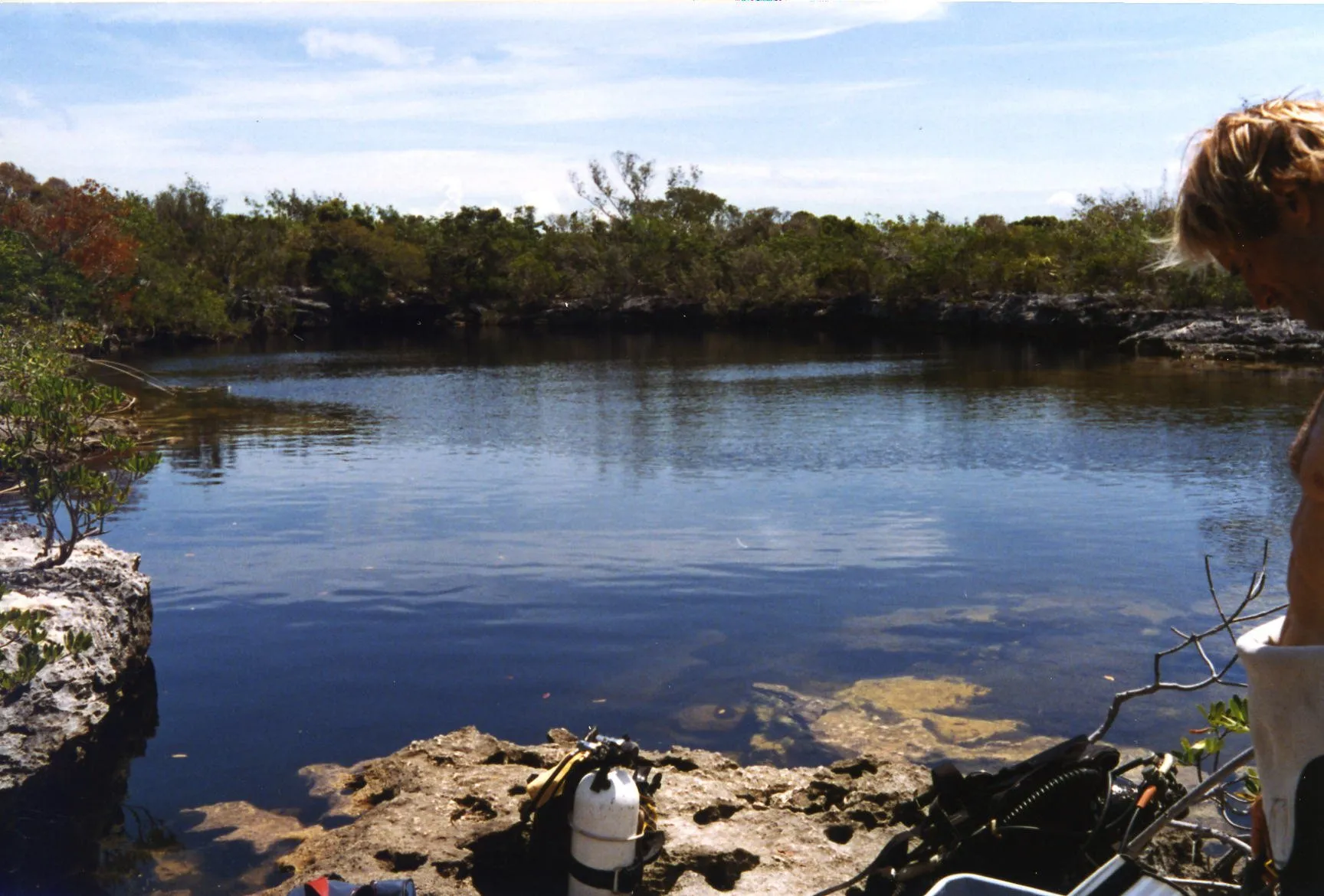
Guardian Blue Hole, an inland blue hole elsewhere on Andros. Photo: R Pollack, public domain.

What a blue hole is
A blue hole is a large cave or sinkhole in limestone that is open to the surface and filled with water. Blue holes are typical of shallow limestone platforms such as the Bahama Banks.
They formed during past ice ages, when sea level stood 100 to 120 metres lower than today. Rain dissolved caves into the exposed rock, and stalactites and stalagmites grew in the dry chambers. When the ice melted, the sea rose and flooded them.
Inland and ocean holes
Ocean blue holes are extensions of the sea. They have the same heavy tides and many of the same species as the water around them.
Inland blue holes have little tidal flow, so the water settles into layers: a thin lens of fresh rainwater over denser salt water. The fresh layer acts as a lid and keeps oxygen out of the salt water below. Bacteria living just under it give off hydrogen sulfide, a toxic gas, which can hang in a visible layer.
Why Andros has so many
The Bahamas National Trust explains it simply: the island’s limestone bedrock was exposed to the elements for thousands of years and eroded into a vast system of caves. The numbers quoted:
- More than 180 blue holes on Andros, inland and along the shore, according to the Bahamas Ministry of Tourism, which calls this the highest concentration anywhere.
- “Nowhere else on earth has more”, in the words of the Bahamas National Trust.
- More than 1,000 blue holes are believed to exist in The Bahamas as a whole, National Geographic reported in 2010, with fewer than 20 per cent explored.
Treat every count as an estimate.
What scientists have found
Early exploration. George Benjamin, a diver from Toronto, spent years exploring the Andros holes and wrote about them in National Geographic in 1970. Jacques Cousteau filmed the Andros blue holes the same year.
Rob Palmer. The cave diver Rob Palmer led a series of expeditions, the largest being the Andros Project of 1987,. He named Stargate, an inland hole on Andros with a central shaft about 340 feet deep. In 1991 his team recovered the remains of 17 Lucayans, the people who lived in The Bahamas from the sixth to the fifteenth century, from a cave on Andros called Sanctuary. Palmer died on a dive in the Red Sea in 1997.
The Bahamas Blue Hole Expedition. In the summer and autumn of 2009, a team funded by the National Geographic Society, working with the National Museum of The Bahamas, spent two months on Andros, Abaco and five other islands. The divers made about 150 dives in dozens of holes. National Geographic reported on it in August 2010. Among the findings, and the earlier work they built on:
- Cave animals. Remipedes, a class of blind crustaceans first documented in The Bahamas in 1981, are “living fossils” little changed in 300 million years.
- Bacteria. Microbes from five inland holes shared no species. They are studied as a model for life without oxygen.
- Fossils. Low oxygen preserves bones and even leaves. Finds include crocodile and tortoise remains thousands of years old.
Blue Holes National Park
The Bahamas National Trust manages Blue Holes National Park, established in 2002. It covers 40,000 acres and protects 22 inland blue holes with the pine and coppice forest around them. The Trust lists its location as North Andros, so it is a separate trip from Mangrove Cay. See nearby on Andros.
Its best-known hole is Captain Bill’s, almost perfectly round and more than 100 feet deep, with a trail, a boardwalk and steps into the water. When this page was checked, the Trust’s website showed the park hours as “closed temporarily”. Confirm with the Trust before you travel.
The Lusca
Bahamian folklore puts a monster in the blue holes: the Lusca. It is described as a giant octopus, or as half shark and half octopus. Benjamin recorded that a guide warned him in the 1950s that the Lusca, “Him of the Hands”, would kill him if he entered the ocean holes. There is no scientific evidence for such an animal.
The danger behind the story is real. National Geographic described a whirlpool at one ocean hole, on Grand Bahama, that sucks down millions of gallons when the tide comes in.
Safety
- Surface swimming only, unless trained. Entering a flooded cave is cave diving. It needs cave training, redundant equipment, a guideline and a qualified guide.
- Watch the tide at ocean holes. Flow reverses with the tide and can be strong.
- Never go alone. These are natural sites without lifeguards.
- Take nothing and leave nothing. Blue holes hold fragile formations and rare animals, and they are tied to the islands’ fresh water.
Where the Victoria Point Blue Hole fits
Mangrove Cay has its own blue hole on the coast at Victoria Point, at the southern end of a wadeable bonefish flat. Guidebooks single it out as the island’s best snorkelling and diving site. It is unsupervised. No published survey of its depth was found for this page, so do not assume it is shallow. The Victoria Point Blue Hole guide has directions and advice.
For the deep water off the east coast, see the Tongue of the Ocean and the Andros Barrier Reef. See also the Andros overview.
Questions people ask
How many blue holes are there on Andros?
The Bahamas Ministry of Tourism says Andros has more than 180 blue holes, inland and along its shore. The Bahamas National Trust says no place on earth has more. Counts differ between sources because many holes have never been surveyed.
What is the difference between an inland and an ocean blue hole?
Ocean blue holes open on the sea floor and behave like part of the sea, with strong tidal flow. Inland blue holes have little tidal flow, so a thin layer of fresh rainwater sits on top of denser salt water with almost no oxygen below.
How were the blue holes formed?
They formed during past ice ages, when sea level was 100 to 120 metres lower and rain dissolved caves into the exposed limestone. When the sea rose again, the caves flooded.
What is the Lusca?
The Lusca is a creature of Bahamian folklore said to live in the blue holes of Andros. It is described as a giant octopus or as half shark and half octopus that drags swimmers and boats under.
Can you swim or dive in the blue holes of Andros?
People swim at the surface of some holes, such as Captain Bill's Blue Hole in Blue Holes National Park. Going into the caves is cave diving and is only for divers with cave training, the right equipment and a qualified guide.
Is there a blue hole on Mangrove Cay?
Yes. The Victoria Point Blue Hole, on the southeast coast between Swain's Cay and Lisbon Creek, is the best-known snorkelling and diving site on the cay.
Sources
- Deep Dark Secrets, National Geographic Magazine (August 2010)
- Blue Holes National Park, Bahamas National Trust
- Parks of Andros, Bahamas National Trust
- Andros Island, The Official Website of The Bahamas
- Blue hole, Wikipedia
- Lusca, Wikipedia
- History, Rob Palmer Blue Holes Foundation
- Andros, The Bahamas, Wikipedia
Last reviewed .